
How to Choose Your Foundation Shade in Pakistan
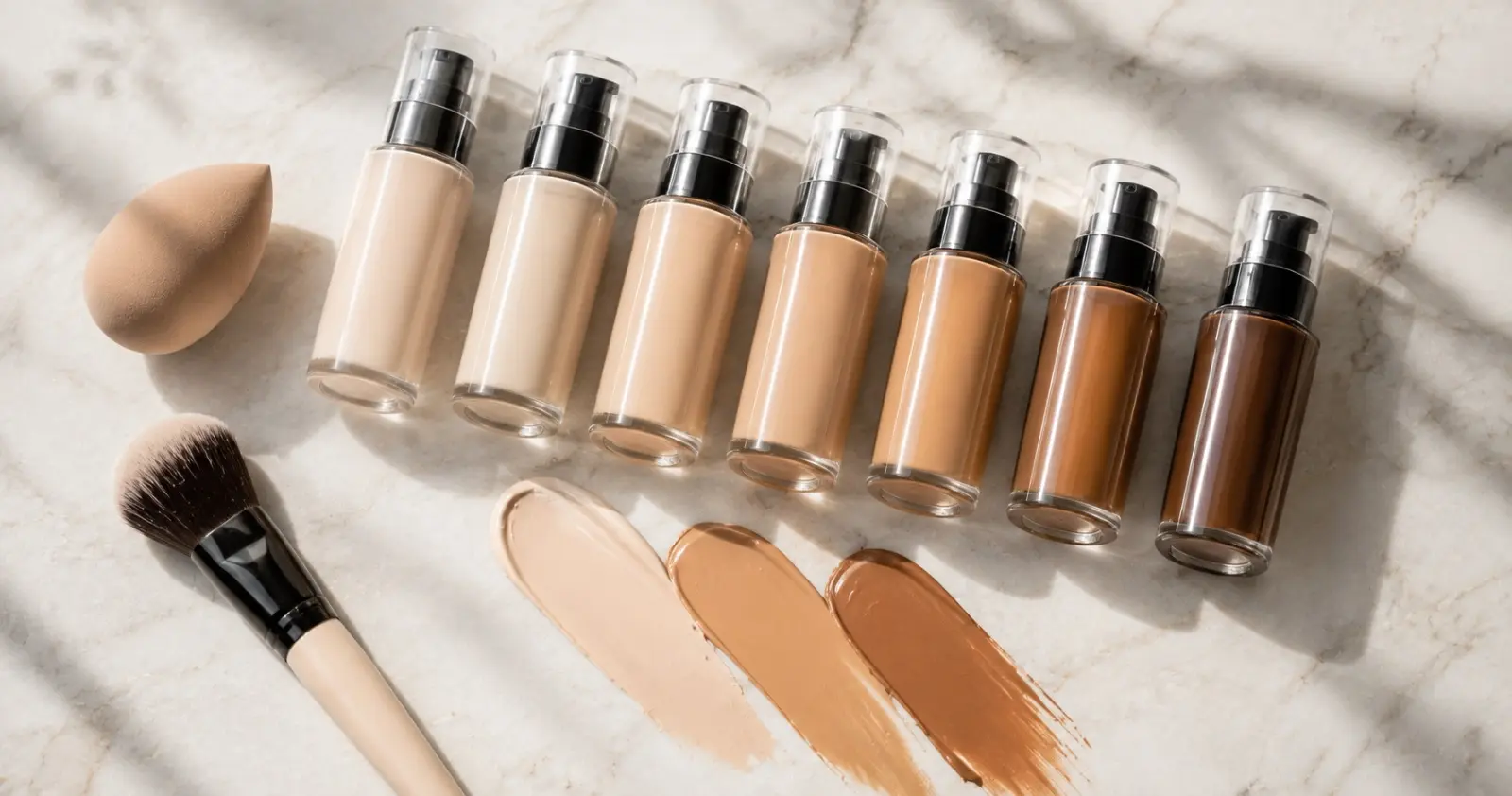
How to Choose Your Foundation Shade in Pakistan
Foundation is where most makeup money gets wasted. Not because the products are bad — because the shade is wrong, and a wrong shade is unwearable no matter how good the formula is.
Buying online makes it harder. You cannot swatch, the lighting in product photos is unreliable, and shade names like "Natural Beige" mean different things to different brands.
This guide covers how to work out your undertone and depth without a store, why foundation looks darker an hour after you apply it, and what to do when you get it wrong.
Two Things Decide Your Shade
Depth is how light or deep your skin is. Fair, light, medium, tan, deep.
Undertone is the colour underneath — warm, cool, neutral or olive. It does not change with a tan and it does not change with the season.
Most people match depth correctly and get undertone wrong. That is what causes foundation to look grey, orange or masklike even when the lightness is right.
Finding Your Undertone
Three tests. Do all three — if two agree, you have your answer.
1. The vein test
Look at the veins on the inside of your wrist in natural daylight.
- Green → warm undertone
- Blue or purple → cool undertone
- A mix, or hard to tell → neutral
2. The jewellery test
Which suits you better against your skin?
- Gold → warm
- Silver → cool
- Both look fine → neutral
Most people in Pakistan find gold more flattering, which is consistent with the majority being warm or olive.
3. The white cloth test
Hold a pure white cloth next to your bare face in daylight.
- Skin looks yellow or golden → warm
- Skin looks pink or red → cool
- Skin looks greenish or ashy → olive
Olive Is Its Own Category — and It Is Common Here
A large share of South Asian skin is olive: a green or grey cast underneath rather than a straightforwardly yellow or pink one.
Most brands do not make olive shades. They make warm and cool, and olive-skinned people end up matching to warm — which is why the foundation looks slightly orange, particularly in photographs.
If foundations consistently look too orange on you despite matching your depth, you are probably olive and matching warm. Go one shade cooler or more neutral than feels right, or mix two shades.
This is also why foundation can look fine in the mirror and wrong in a wedding photo. Flash exposes an undertone mismatch that daylight hides.
Finding Your Depth Without a Store
Swatch on your jawline, never on your hand. The back of your hand is usually several shades darker than your face, and matching to it is the most common reason foundation ends up too dark.
Apply three candidate shades in stripes along the jaw, blend lightly, and step into natural daylight. The right shade disappears. If you can see where it starts and stops, it is wrong.
Check that it works against your neck as well as your face. A foundation that matches your face but not your neck leaves a visible line, and that line is what people notice.
Foundation Darkens After You Apply It
This one catches everyone.
Many foundations oxidise — they react with air and with the oils in your skin and turn darker or more orange over the first thirty to sixty minutes. A shade that matched perfectly at 8am can look noticeably off by 9am.
So test in real time. Apply, then wait an hour before deciding. If it oxidises badly, going half a shade lighter than your true match compensates for it.
Oily skin oxidises foundation faster than dry skin. Setting with powder slows it down.
Foundation, BB Cream or CC Cream?
| BB Cream | CC Cream | Foundation | |
|---|---|---|---|
| Coverage | Light | Light to medium | Medium to full |
| Finish | Natural, dewy | Natural | Varies |
| Shade range | Narrow — often 2–3 | Narrow | Wider |
| Skincare in it | Usually | Usually | Sometimes |
| Best for | Everyday, good skin days | Redness, uneven tone | Events, coverage |
BB creams are more forgiving on shade because the coverage is sheer — your own skin shows through and corrects a near-miss. That makes them the safer first purchase when buying online.
The trade-off is choice. Most BB creams come in two or three shades that cannot possibly suit everyone, so read the shade descriptions carefully rather than assuming "natural" means your natural.
A Word on Colour-Changing Foundations
These are marketed as adapting to any skin tone. They do not, quite.
What they actually contain are capsules of pigment that break on application, releasing a shade that suits a moderate range around a fixed midpoint. If you sit within that range, the result is good and genuinely convenient. If you are significantly fairer or deeper than the midpoint, it will not stretch to you.
Useful if you are close to average depth and want something forgiving. Not a substitute for a proper shade match if you are at either end of the range.
What We Stock
NARS Light Reflecting Foundation — Rs. 1,499 · 30ml
Medium buildable coverage with a natural luminous finish. Silicone-free, so it layers cleanly over water-based skincare.
Please read this before ordering: we stock Siberia, Oslo and Mont Blanc, and all three are light to fair shades. If your skin is medium, tan or deep, none of them will match you. We would rather lose the sale than send you a foundation several shades too light.
Add your other foundations and BB creams here — XQM, Maliao, Century Beauty, FV and any colour-changing formulas. Include the shade names, price and a link for each. Where a product only comes in fair shades, say so, exactly as above.
If You Get It Wrong
Slightly too light: mix in a little bronzer or a drop of a darker foundation. Or use it as an under-eye brightener.
Slightly too dark: mix with moisturiser to sheer it out, or use it as a contour.
Too orange: your undertone is off, not your depth. Look for neutral or cool in the same depth.
Grey or ashy: the opposite — too cool for you. Go warmer.
Two shades that are each slightly wrong in different directions can be mixed into one that is right. Many people with olive or in-between skin end up doing this permanently.
Before You Order Online
- Know your undertone. Do the three tests above.
- Read the shade description, not the shade name.
- Check whether the range includes your depth at all before comparing shades within it.
- Start with a BB cream if you are unsure — sheer coverage is far more forgiving.
- Ask. Message us on WhatsApp with a photo of your inner forearm in daylight and we will tell you honestly whether something will work.
That last one is worth using. A two-minute message costs nothing and prevents a wasted purchase.
Frequently Asked Questions
How do I find my foundation shade at home?
Determine your undertone with the vein, jewellery and white cloth tests, then swatch on your jawline in daylight. The correct shade disappears rather than showing a line.
Why does my foundation look orange?
Your undertone is mismatched, not your depth. If you are olive-skinned and matching to warm shades, this is the usual cause. Try neutral or cool at the same depth.
Why does my foundation get darker during the day?
Oxidation — the formula reacts with air and skin oils. Test by waiting an hour before judging, and go half a shade lighter if it oxidises badly.
Should I match foundation to my face or neck?
Both. Swatch on the jawline, which sits between the two. A foundation matching only the face leaves a visible line at the jaw.
Is BB cream better than foundation?
Neither is better — they do different jobs. BB cream is sheerer, more forgiving on shade, and better for everyday. Foundation gives coverage for events and photographs.
Do colour-changing foundations really work?
Within a range around their fixed midpoint, yes. Outside that range they will not adapt to you.
Can I mix two foundation shades?
Yes, and many people with olive or in-between skin do it permanently. It is often the best answer when no single shade in a range fits.
Shop Foundation
All original stock with nationwide delivery and cash on delivery available. Free delivery on orders above Rs. 3,200.
Not sure which shade suits you? Message us on WhatsApp before ordering — we would rather help you get it right than process a return.
